
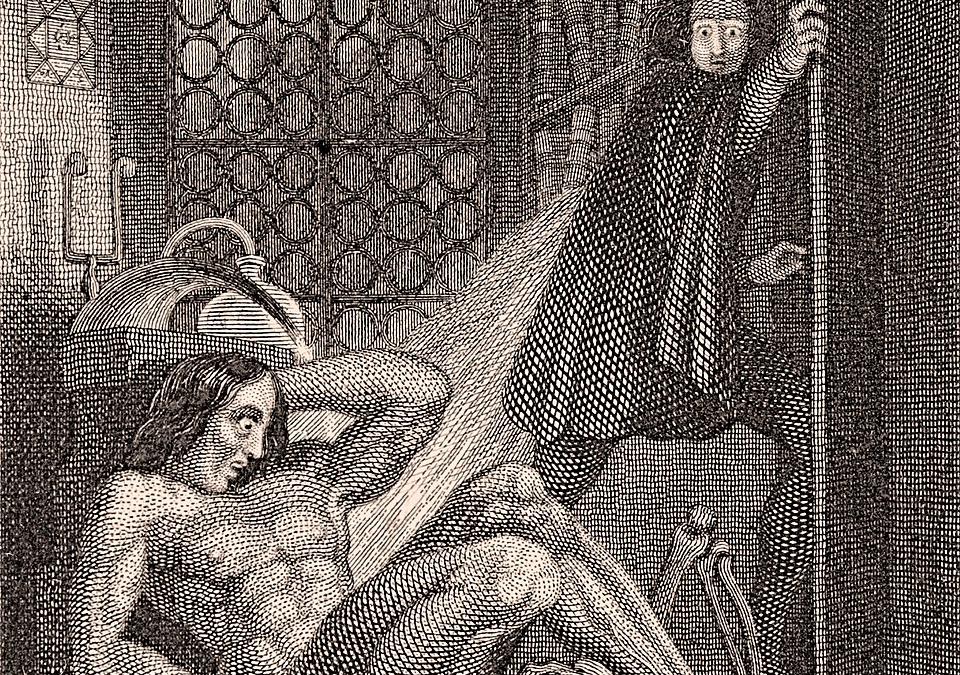
Normally when I talk about Frankenstein, the book, I talk about how Frankenstein’s monster is an analogy for postpartum depression.
How a teenager gave birth to a child which died, and was revolted – and wondered if that lack of a mother’s love was its undoing.
I have no love of this thing I have created, I feel nothing and despite wanting – needing – to feel it to be a good person, I cannot.
The child found wanting becomes the parent’s undoing.
Mary Shelley was depressed and writes honestly of her horror and revulsion at seeing her child for the first time. At having no love for this *thing* she had created.
But there’s another story there and it’s one Guillermo del Toro touches on immensely in the latest (as of writing) rework of Shelley’s book.
I was born and you rejected me
How could a creator who is good do this to me?
If you are my father, I reject you.
If nature rejects me, if life is unkind, it is only because I have looked my creator in the eye and found him unworthy.
Del Toro gave the father a redemption arc, one in which the good doctor realizes the severity of his crimes, not in creating something, but in failing to be a father. That failure is the crux of the film, in which a creator makes somethingone unknowingly, without realizing that the child he is creating is a child, has needs, and will look to him for emotional support and guidance. He looks upon his child and he is terrified. In creating life, he has created something he can neither know nor understand.
That is, of course, kinder than the picture we paint of the Christian god, the Almighty, the all-knowing, omniscient and aware of all that has been and all that will be.
What am I to think of this god who, knowing my future and knowing my path, created me anyway?
Do I then have free will?
Of course I have free will. I choose the path and while I do not control the black box, the void, which forms the wellspring of thought and action, I steer the inputs and that black box is me. I am a collection of my experiences and knowing that my path is set and therefore knowable is an alien thought that frankly would make life anathema to me.
Could a god that loves me bring me into this world knowing my path?
Or does that feel more like a sick joke, like a C.S. Lewis writing Eustace Scrubb only to revile him and make of him a villain:
“There was a boy called Eustace Clarence Scrubb, and he almost deserved it.” _ C.S. Lewis, The Lion, the Witch, and the Wardrobe
“I’m not bad, I’m just drawn that way” _ Who Framed Roger Rabbit
That theme is one which is more frequently explored in media. In “O’Malley’s Bar“, Nick Cave paints the picture of a murderer using God, his own delusion of the divine, to justify his murder of the local bar patrons, quoting “If I have no free will how can I then be morally culpable”.
The (masterful) satire of the passion of the Christ, Jesus Christ Superstar, following both Jesus and his Apostles through the final days of Christ’s life and death begins with an overture by Judas – quickly turning into a judgement, a cry for caution, Jesus is not the son of God but a man and his delusions of grandeur will get them killed. Judas sings his way through his betrayal, swapping Jesus’ whereabouts for “this is not blood money, it is a fee, nothing more”, only to quickly experience remorse as he learns what is to become of his (best)friend.
In the act leading to Judas’ suicide, the betrayer reveals his knowledge of the omniscience of God. If God knows everything, Judas’ path was predestined, the betrayer is the betrayed.
But I only did what you wanted me to,
Christ, I’d sell out the nation,
For I have been saddled with the murder of you
I have been spattered with innocent blood
[]
My God
I am sick
I have been used
And you knew all the time!
God!
So, can a God who is good knowingly create another to commit his foul, bloody crimes?
Also not a thought unique to me:
The god who made kittens put snakes in the grass _ Thick as a Brick, Jethro Tul
If god exists, he cannot also be good _ Lex Luthor (ooh quoting supervillains, classy, I know)
Do I feel safe with a God that can know all and understand the weight and meaning of what He has created and then still create a world where staying alive relies on the consumption of the flesh of other living things? Do I want to run to his arms and find a safe place to hide? When there are people right here who find that kindness is the most important maxim, and that’s enough, why can’t that be enough – would choosing the divine be nothing more than an act of fear, because I can lose people and God is an unwavering constant I cannot lose? For, indeed, there is so much safety in not being able to lose something.
If I had been god, I would have sired many sons and I would not have suffered the Romans to kill even one of them. _ Deja Vu, Roger Water
Freud’s interpretation of dreams considers the concept of concomitant hostility to the father to remove competition for affection for the mother, a first step in sexual competition. (Freud is utter nonsense of course).
But there’s a thought there, the hostility to the father, the butting of heads against the patriarch, the desire to go out and pave your own path – to break the generational patterns and do a better job. Not for everyone, of course, but enough.
Maybe hostility with the father is not in that he is competing for the affection of the person actually taking care of us, but in the fact that it’s not him taking care of us. His world is one of poverty, disease, rampant unfairness. There is a man sleeping under the viaduct near my house many nights, and I can do nothing about it.
If god is real in the sense of the all powerful, the all knowing, then can he also be good?
When I was about 12, I had a kitten and, being an American family without any regard for life, that kitten was allowed to go outside.
Sunning on a rock one day, its little kitten body curled into a soft ball of fluff, that kitten was snatched by a hawk and in a split of a second it was gone.
“If I had been a drone, I would be afraid, to find someone home – maybe a woman at a stove, baking bread, making rice, or just boiling down some bones” _ Roger Waters.
Things die every day. I do not begrudge the hawk her meal.
Things die so I can eat them.
I feel the moral weight of it.
But what if I loved that kitten? Does loving something give it a greater right to life. No. Everything dies.
For my entire life everything I have ever loved has at some point or another been swept away and I have no say in the matter, no power to cling to life or things that are precious to me, I make the most of time when I have it, that’s just how life works. I must be able to lose things if I am to love them. Only a god could ever break this harsh rule of how life works.
So there’s some hypocrisy there, if things are allowed to die, why, then, would a god need to take care of things to love them?
Why then would I hold a god to a higher standard than I hold the world?
These hands have been bloodied by the birthing canal and the butchering knife.
Bringing socialist sentiment into the matter, in The Essence of Christianity (1841), Feuerbach writes that God, the divine, is an expression of all of humanity’s most desirable traits. The things we most value about ourselves. His entire philosophy was an effort to move those traits away from religion, especially state religion, and into humanity so that we do not tie values to a theocracy but to the essential act of being human. Something we truly cannot lose.
And if a God is, what? An expression of the self, individual to the person, a personal and a private thing in a way that no other thing can be. A maxim for yourself, a driving power to look up to and hold close to yourself when the nights are long and sleep is short.
So God created man in his own image, in the image of God created he him; male and female created he them. _ Genesis 1:27
If god made man in his own image, then man must have made god in his own image. A mirror reflection of both creature and creator.
And in creating a god, am I writing with love, with kindness the only maxim, or am I creating a Eustace Scrubb, not bad, just drawn that way – Judas, deserving of his fate because of the character He was given, to commit my foul, bloody crime of taking responsibility for my sins. Because, in being all knowing, he created me anyway. How can I then be morally culpable. Am I not then just as bad as the thing that I flinch from.
Frankenstein brought his creature into the world knowingly, and wrote on its blank slate “monster”, a defilement of nature, an evil thing. And in choosing its own path, the monster rejected the father.
Frankenstein’s creature, Frankenstein’s Adam, for he is an Adam, originally takes no such hubris onto himself. In the book he retreats into the ice, away from the natural world which reviles him, learning from the sins of the father. Prometheus, the lowly challenger choosing kindness in the face of the all-knowing cruelty of Zeus.
But that’s not always so is it? Man rewrites him again and again, handing him the same bloody hubris that brought him to life.
In the Bride of Frankenstein, Adam wishes to beget himself a bride, to become both father and husband, and in so doing, brings to life a creature beyond his control and beyond his comprehension. An Eve from his own rib who defiles mankind with her act of rebellion.
While he does not reject his progeny, she rejects him instead – and he kills her for it. A blank slate, deserving of her fate, because of her refusal to follow the path she was given. A circle, unbroken.
My God, my God, why hast thou forsaken me? — Matthew 27:47